

THOSE WITH EXCESS WEIGHT
THOSE WITH EXCESS WEIGHT
Excess adipose tissue (body fat) may lead to falsely normal values.2


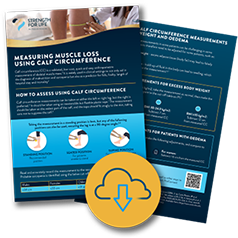
Calf circumference (CC) is a validated, low-cost, quick and easy indirect measure of skeletal muscle mass.1 It is widely used in clinical settings to not only aid in the diagnosis of malnutrition and sarcopenia but also as a predictor for falls, frailty, length of hospital stay and mortality.2
.png/_jcr_content/renditions/cq5dam.web.1280.1280.jpeg?ch_ck=1712045731000)
Calf circumference measurements can be taken on either the left or right leg, but the right is preferred.3 It should be taken using an inextensible and flexible plastic tape.1 The measurement should be taken on the widest part of the calf, and the tape should fit snugly to the skin, taking care not to suppress the calf.3
Calf circumference measurements can be taken in a standing position, or in a seated or supine position - with the leg at a 90 degree angle:3-5

STANDING POSITION
For patients who are capable of standing

SEATED POSITION
For patients unable to stand

SUPINE POSITION
For patients in bed who are unable to sit or stand

Read and accurately record the measurement. Probable sarcopenia can be identified using the below cut-offs:6
| Calf Circumference cut-off | Males | Females |
|---|---|---|
| Moderately low CC | 34 cm | 33 cm |
| Severely low CC | 32 cm | 31 cm |
Taking calf circumference measurements in some patients can be challenging in certain circumstances. Measurements therefore need to be adjusted for some patients, such as:
Excess adipose tissue (body fat) may lead to falsely normal values.2

Build-up of fluid in the body can lead to swelling, which may artificially increase the measurement.7,8
For individuals with a BMI ≥ 25 kg/m2, take the measurement as normal, then make the following adjustments, and compare to the cut-off table above.2

BMI 25-29.9 kg/m2:
Subtract 3 cm from measured CC
BMI 30-39.9 kg/m2:
Subtract 7 cm from measured CC
BMI ≥40 kg/m2:
Subtract 12 cm from measured CC
Take the measurement as normal, then make the following adjustments, and compare to the cut-off table above.8

For men:
Subtract 2 cm from the measured CC

For women:
Subtract 1.6 cm from the measured CC

The tables outlined below show calf circumference percentiles adjusted for age/gender.
NORMATIVE VALUES OF CALF CIRCUMFERENCE IN MEN, STRATIFIED BY AGE*
| Age (Years) | Observations | Centiles | Mean (SD) | ||||
|---|---|---|---|---|---|---|---|
| 5th | 25th | 50th | 75th | 95th | |||
| 45-49 | 595 | 33.0 | 35.5 | 37.0 | 39.0 | 42.6 | 37.1 (3.4) |
| 50-54 | 771 | 32.8 | 35.5 | 37.0 | 39.0 | 42.5 | 37.4 (3.4) |
| 55-59 | 881 | 32.0 | 35.0 | 37.0 | 39.0 | 42.5 | 37.1 (3.4) |
| 60-64 | 753 | 31.5 | 35.0 | 36.7 | 39.0 | 42.0 | 36.8 (3.6) |
| 65-69 | 704 | 31.2 | 34.4 | 36.3 | 38.6 | 42.0 | 36.5 (3.2) |
| 70-74 | 675 | 31.0 | 34.0 | 36.0 | 38.0 | 41.0 | 35.9 (3.0) |
| 75-79 | 436 | 30.0 | 33.0 | 35.4 | 38.0 | 41.0 | 35.3 (3.2) |
| 80+ | 304 | 30.0 | 32.5 | 35.0 | 37.0 | 41.0 | 35.0 (3.4) |
NORMATIVE VALUES OF CALF CIRCUMFERENCE IN WOMEN, STRATIFIED BY AGE*
| Age (Years) | Observations | Centiles | Mean (SD) | ||||
|---|---|---|---|---|---|---|---|
| 5th | 25th | 50th | 75th | 95th | |||
| 45-49 | 833 | 30.0 | 33.5 | 35.5 | 38.0 | 42.0 | 35.6 (3.5) |
| 50-54 | 1201 | 30.0 | 33.0 | 35.0 | 37.0 | 41.0 | 35.1 (3.5) |
| 55-59 | 1126 | 30.0 | 33.0 | 35.0 | 37.0 | 41.0 | 35.0 (3.6) |
| 60-64 | 1010 | 29.5 | 32.6 | 35.0 | 37.0 | 40.2 | 34.8 (3.5) |
| 65-69 | 956 | 29.2 | 32.2 | 34.2 | 36.5 | 40.0 | 34.5 (3.3) |
| 70-74 | 759 | 29.0 | 32.0 | 34.0 | 36.5 | 40.0 | 34.3 (3.3) |
| 75-79 | 514 | 28.5 | 31.6 | 34.0 | 36.0 | 39.0 | 33.7 (3.3) |
| 80+ | 296 | 28.0 | 31.0 | 33.1 | 35.8 | 39.0 | 33.4 (3.3) |
*Table taken from Martone AM et al.1
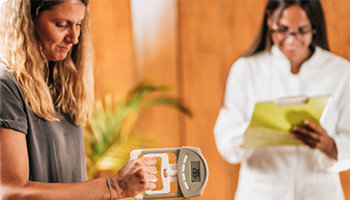
Abbott is committed to supporting you and your patients achieve the best possible outcomes, and as part of this commitment, Abbott is providing your Trust with a handgrip dynamometer to be used in patient assessments and to help monitor intervention strategies and patient progress.

Frail and sarcopenic patients are at increased risk of malnutrition and muscle loss, which in turn, can escalate the progression of frailty. However, frailty can be treated and promoting healthy ageing from middle age onwards could delay its onset as people grow older.
Vitamin D and protein for muscle health
This article by Richie Kirwan, discusses the casual effect that vitamin D potentially has in increasing muscle mass. There is emerging evidence for the importance of vitamin D in musculoskeletal health. Therefore, ensuring adequate serum vitamin D levels is a realistic and easy strategy to improve muscle health. Vitamin D, combined with resistance exercise and adequate protein intake could help improve quality of life and reduce the risk of common, chronic diseases of ageing.
References:
1. Martone AM et al. Journal of Cachexia, Sarcopenia and Muscle 2023:10.1002/jcsm.13286.
2. da Costa Pereira JP et al. Nutrition 2024;112505.
3. Todorovic VE. Mafrici B. A Pocket Guide to Clinical Nutrition 2018. 5th edition 2.35-2.36.
4. Piodena-Aportadera M. et al. Ann Geriatr Med Res 2022;26(3):215-224
5. Selvaraj K et al. J Family Med Prim Care. 2017;6(2):356-359.
6. Gonzalez, MC et al. Am J Clin Nutr 2021 Jun 1;113(6):1679-1687
7. Lent-Schochet D & Jialal I. StatPearls Publishing 2024. Available from: https://www.ncbi.nlm.nih.gov/books/NBK537065/.
8. Ishida Y et al. Geriatrics and Gerontology International 2019;19(10).

SESSION TIMEOUT
Please log in to continue
Thanks for registering. To begin, please log in to your ProConnect account. After you log in, you’ll have temporary access to all resources and education while we verify your details.
UK--2500117 (V2) | December 2025


Added to Bag
ENSURE PLUS
1 x 220 ml
Flavor: Apple
1,5 kcal / ml
Nutrition Information
| Unit | Per {ml-col-1} ml | Per {ml-col-2} ml |
| Unit | Per {ml-col-1} ml | Per {ml-col-2} ml |
| Unit | Per {ml-col-1} ml | Per {ml-col-2} ml |
footnotes
Product details not available.
You have {liteUserDaysLeft} business days of temporary access.
Based on your email address {email} your account has not yet been approved. We’re validating your credentials. You won’t be able to order samples until your account is approved and activated. Please check your email for more details. For help, contact us at abbott.proconnect_access@nhs.net.
UK--2500192 | September 2025
You have {liteUserDaysLeft} business days of temporary access.
Based on your email address {email} your credentials are validated but not yet activated. To gain full access, including the ability to order samples, click the activation link we sent to your inbox. For help, contact us at abbott.proconnect_access@nhs.net.
UK--2500192 | September 2025
Register to continue reading this article
UK-N/A-2400058(v9) | September 2025
You are about to exit for another Abbott country or region specific website.
Please be aware that the website you have requested is intended for the residents of a particular country or region, as noted on that site. As a result, the site may contain information on pharmaceuticals, medical devices and other products or uses of those products that are not approved in other countries or regions.
The website you have requested also may not be optimised for your specific screen size.
Do you wish to continue and exit this website?
UK-N/A-2200465 | July 2022

This website is for UK HCPs and UK Patients only. If you are outside of the UK please visit our global website Abbott.com
If you choose "I am a patient/carer”, you will be entering a website intended for patients and carers which has information on Abbott products. Products on this website are to be used under medical supervision. If you have questions about the product information discussed on this website, you should consult with your healthcare professional.