

ARIZE CASE STUDY: FEED TOLERANCE IN NON-CMPA INFANT
Freya’s healthcare professional: Lauren McVeigh, Regional Specialist Paediatric Dietitian in Gastroenterology
IMPORTANT NOTICE: Breastfeeding is best for infants and is recommended for as long as possible during infancy. Arize is an infant formula for special medical purposes and should be used under medical supervision.
.png)
MEDICAL AND NUTRITIONAL HISTORY
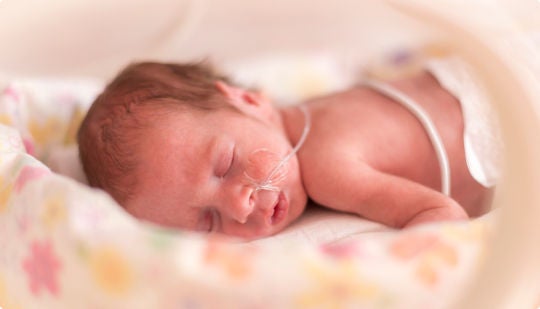
Freya was born preterm at 35+5 weeks with antenatally diagnosed gastroschisis. At delivery, her gastroschisis was classified as simple (not complex) and did not require surgical intervention beyond silo reduction and closure, which took place on day 4 of life. All infants with gastroschisis will commence on parenteral nutrition (PN) as soon as possible after birth, as even in uncomplicated gastroschisis, it can take up to 2 weeks to graduate to full enteral feeds. Freya was initiated on PN from day 2 of life.
At this time, there were no obvious indications or concerns about impaired gastrointestinal function, and it was thought she would transition to full enteral feeding relatively quickly. However, Freya struggled to establish feeds, with high aspirates and vomiting that prevented initiation of enteral feeding. She was kept nil by mouth and remained on full PN, which met her nutritional requirements and supported steady weight gain.

NUTRITIONAL TREATMENT
At week 6, Freya’s aspirates began to settle, and the surgical team suggested that trophic feeds could commence. Though breastmilk is the preferred feed of choice whenever possible, it had been confirmed prior to birth that Freya’s mother did not wish to breastfeed or express. Freya was therefore initiated on an extensively hydrolysed formula (eHF) - which was the standard formula choice for surgical neonates - at 5ml every 3 hours via nasogastric tube (NGT), together with erythromycin.
Her persistently high volume of aspirates and concerns about abdominal distension meant this had to be stopped. A nasojejunal tube (NJT) was inserted at week 8 to bypass the stomach, with trophic feeds of 1ml/hour; however, her aspirates once again rose, and feeds were stopped due to sepsis concerns. Her NJT was repositioned and re-sited with the aim of improving her response, but these attempts were continually met with a rise in aspirates, which only settled during feed cessation. The decision was made to continue with trophic feeds in the hope that tolerance would improve, and to replace aspirate volume intravenously, in addition to full PN.
Nutritional Intervention with HRF
At age 11 weeks, Freya was transferred from the Neonatal unit in St Michael’s Hospital (Bristol) to Bristol Royal Hospital for Children to address her feed tolerance issues and see if long-term PN usage could be avoided. Although the cause of her dysmotility issues was not clear, in light of her ongoing poor tolerance, the multi-disciplinary team (MDT) elected to trial Arize - a hydrolysed rice formula (HRF), rather than an amino acid formula (AAF) - at 1ml/ hour via NJT. Though AAF might usually be considered following a lack of success with eHF, the MDT recognised evidence suggesting that short-chain peptides could be more beneficial than free amino acids for long-term gut adaptation, particularly in post-surgical babies.
Freya had an immediate positive response to Arize, with sustained improvement in feeding tolerance and her aspirates no longer a problem. Feed volume was gradually increased, in parallel with a tapered reduction of PN, from 1ml/hour at week 11 to 25ml/ hour by week 15. Freya later displaced her NJT, prompting the trial of continuous NG feeding, which was well tolerated with no vomiting. In week 16, PN was stopped, and daytime oral feeds were introduced alongside overnight continuous NGT. The tapered approach was then taken again to wean her off enteral feeding. She responded well to daily bottle feeds, accepting the taste, and successfully transitioning to full oral feeding within 1 week.

OUTCOMES
When discharged home at 17 weeks, Freya was accepting and tolerating full Arize bottle feeds. She has since remained well and growing as expected, with no further feed intolerance, vomiting or issues with stooling. Upon follow-up at 26 weeks, she had started some solids - including a small amount of dairy (yoghurt and cheese) - and had begun to transition to a standard infant formula, with no further gastrointestinal issues.

KEY FINDINGS
- Arize was effective immediately, compared to multiple unsuccessful trials of eHF.
- While there was nothing to suggest that Freya had cow's milk protein allergy (CMPA), her response to Arize demonstrates its safe and effective application for infants with non-CMPA gastrointestinal conditions.
- Selecting a viable formula that is both well-tolerated and palatable can be beneficial for acceptance when switching to oral feeds.
- The MDT considered Arize suitable for wider use across different patient groups in infant gastroenterology.

READ THE FULL CASE STUDY
RELATED CONTENT
PaediaSure Peptide Case Study Cerebral Palsy
- Main Image
-

- Tagname
- CASE STUDY
- title
- PaediaSure Peptide Case Study – Cerebral Palsy
- Abstract
-
Learn more about Lucas and his health challenges.
- Content Reference
- /content/an/hcpproconnect/uk/en/home/paediatric/resources/public/ps-peptide-cs-cerebral-palsy
PaediaSure Peptide Case Study Short Bowel Disease
- Main Image
-

- Tagname
- CASE STUDY
- title
- PaediaSure Peptide Case Study – Short Bowel Disease
- Abstract
-
Learn more about Rebecca and her health challenges.
- Content Reference
- /content/an/hcpproconnect/uk/en/home/paediatric/resources/public/ps-peptide-cs-short-bowel-disease
Recipe for Eager Elephant's Strawberry Smoothie
Eager elephants strawberry smoothie
- Main Image
-

- Tagname
- RECIPE
- title
- Eager Elephant's Strawberry Smoothie
- Abstract
-
Serves 1
- Content Reference
- /content/an/hcpproconnect/uk/en/home/paediatric/resources/public/hcp-eager-eleph-strawberry-smoothie-v2
Footnotes:
CMPA - Cow’s milk protein allergy.
†2’-FL - 2’-fucosyllactose. Structurally identical to that found in breast milk (not sourced from human milk).