You can enrol in up to 20 courses during temporary access. You’ve reached this limit and can’t enrol in any more right now.
Once you have full access, you’ll be able to enrol without limit.
Identifying malnutrition early is vital to provide timely and appropriate nutritional intervention1
![]()
ARFID is a term which is used for individuals with sensory sensitivity who may avoid eating certain foods due to aversions to specific tastes, smells or textures or who have a general lack of interest in eating or a low appetite.2
ARFID is different from anorexia nervosa, bulimia nervosa, and related conditions in that beliefs about body weight and shape do not contribute to food avoidance.3 There are many reasons why a person may avoid or limit the amount they eat.
The term ‘faltering growth’ (previously called ‘failure to thrive’) refers to slower growth or weight gain in childhood than is typically expected for their age and gender.4
Whilst it is normal for newborn infants to lose weight in the early days of their life and for children to grow at different rates, persistent or significant weight loss is often a cause for concern for healthcare professionals (HCPs) and parents or carers.4
GI symptoms can be relatively common in infants and children and are often quickly managed with medicine or dietary changes. However, undiagnosed GI problems can lead to ongoing issues that could impact a child's growth, development and overall health.5
Among the most common GI conditions are irritable bowel syndrome (IBS), coeliac disease, and inflammatory bowel disease (IBD), which includes Crohn's disease and ulcerative colitis.5 GI conditions can cause symptoms including diarrhoea, vomiting, and gastro oesophageal reflux disease, which may mean the child becomes malnourished or at risk of malnutrition. In severe cases, this can leave to malabsorption, affecting their response to nutritional support and their ability to recover.6
Neurological impairment (NI) relates to disorders of the central nervous system, affecting speech, motor skills, vision, memory, muscle actions and learning abilities.7 NI includes conditions such as cerebral palsy, autism, ADHD and epilepsy.8
It has been estimated that 3-4% of children in England suffer from neurodevelopmental impairment and conditions.8 Cerebral palsy affects 1 in 400 children in the UK.9
Malnutrition is common in children with NI (and is reported in 46-90% of children with cerebral palsy) due to a combination of factors:10
Disease-related malnutrition in paediatric cancer patients is common and can have a significant impact on patient outcomes as well as the disease trajectory.11,12 However, nutrition has a far more fundamental importance with respect to a growing, developing child, meaning the pathology of the disease in children can be very different from that observed in adults.13
Nutrition has a role in most areas and components of the cancer control spectrum, from prevention through to palliation and can impact morbidity and mortality.12
Children with chronic respiratory diseases such as cystic fibrosis (CF), bronchiectasis and childhood interstitial lung disease often suffer from malnutrition as a result of increased nutritional requirements and metabolic stress factors. They may also suffer from reduced physical activity levels due to their condition.14
CF is one of the UK’s most common life-threatening inherited diseases. Around 10,600 people in the UK have CF; or 1 in every 2,500 babies born. Approximately 40% of people on the UK CF register are under 16.15,16

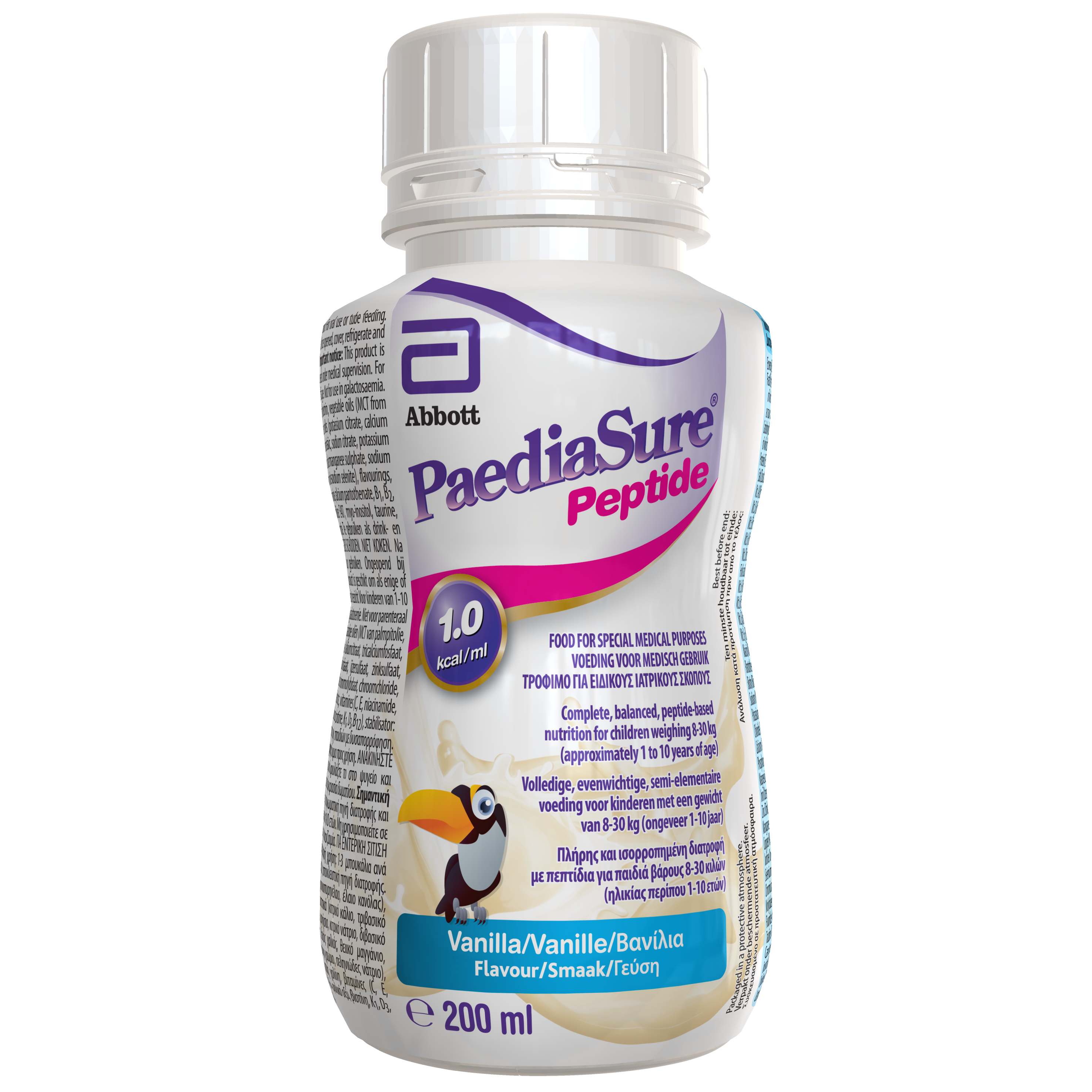
PaediaSure® Peptide
PaediaSure Peptide is suitable for the dietary management of children weighing 8-30 kg with malabsorption or children who experience symptoms of poor feed tolerance.
PaediaSure Peptide is 1.0 kcal/ml, with 100% proteins broken down to peptides*, 50% fat as medium-chain triglycerides (MCT) and clinically lactose free. PaediaSure Peptide is available both as a 500 ml Ready to Hang tube feed and as a 200 ml bottle. It is available in vanilla flavour and is best served chilled.
*Peptides are partially broken down proteins, which makes them easier to digest and absorb in the gut than whole proteins.

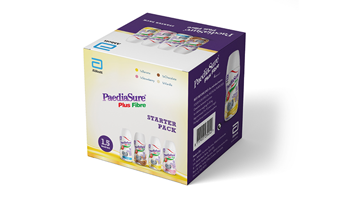
Paediasure Plus Fibre Starter Pack
PaediaSure Plus Fibre is suitable for the dietary management of children weighing 8-30 kg with, or at risk of developing, disease-related malnutrition. PaediaSure Plus Fibre contains a unique mix of ~50:50 fermentable and bulking fibres designed to provide a multitude of benefits in the gut and beyond.

Paediasure Compact Starter Pack
PaediaSure Compact is a 125 ml oral nutritional supplement suitable for the dietary management of children weighing 8-30 kg with, or at risk of developing, disease-related malnutrition. It has been specifically developed for children who may benefit from a smaller volume, as an alternative to ready-to-drink supplements which are 200 ml in volume

Malnutrition is common in children and it can have a devastating effect on patient outcomes. Identifying malnutrition early is vital to provide timely and appropriate nutritional intervention. Learn more about the importance of nutrition, as well as simple and effective ways to screen and treat paediatric patients for malnutrition.
![]()
Discover the impact of the vicious cycle of malnutrition and malabsorption and the power of peptides in the treatment ofmalnourished children with compromised gastrointestinal function.

Pedi R-MAPP is a validated, easy-to-use digital nutritional awareness tool that supports healthcare professionals (HCPs) in completing a nutrition-focussed consultation. It can be used by any HCP, on any part of the patient pathway, either during remote consultations, or as part of a face-to-face appointment.
References:
1. Reber E et al. J Clin Med 2019;8(7):1065.
2. Thomas JJ et a/. Curr Psychiatry Rep 2017;19(8):5.
3. Beat Eating Disorders, 2024. ARFID. Available online: https://www.beateatingdisorders.org.uk/get-information-and-support/about-eatingdisorders/types/arfid/ Last accessed April 2024
4. NICE, 2017. Faltering growth: recognition and management of faltering growth. Available online: Last accessed April 2024
5. NHS, 2022. Gastrointestinal conditions. Available online: https://www.nlg.nhs.uk/resources/gastrointestinal-conditions/ Last accessed April 2024.
6. Selimoglu MA, et al. Frontiers in Pediatrics. 2021;9:2296-2360
7. Romano C, et al. ESPGHAN. European Society for Paediatric Gastroenterology, Hepatology and Nutrition Guidelines for the Evaluation and Treatment of Gastrointestinal and Nutritional Complications in Children With Neurological Impairment. JPGN 2017;65: 242-264.
8.Annual Report of the Chief Medical Officer 2012, Our Children Deserve Better: Prevention Pays. Chapter 9. Children with neurodevelopmental disabilities. Clare Blackburn, Janet Read, Nick Spencer, authors
9. Scope. Cerebral Palsy https://www.scope.org.uk/advice-and-support/cerebral-palsy-introduction Accessed April 2024.
10. Penagini F, et al. Dietary Intakes and Nutritional Issues in Neurologically Impaired Children. Nutrients 2015;7:9400-9415.
11. Joffe L, Ladas EJ. Lancet Child Adolesc Health 2020;4(6):465-475.
12. Rogers PC. Indian Journal of Cancer 2015;52(2):176-8.
13. Rogers PC & Barr RD. Paediatric Blood and Cancer. 2020;6(S3):e28213.
14. Alsharkawy A, et al. Nutritional assessment and rehabilitation in children with bronchiectasis and childhood interstitial lung diseases: effects on pulmonary functions and clinical severity. Egyptian Pediatric Association Gazette 2021;69:42.
15. Cystic Fibrosis Trust. Cystic Fibrosis FAQs. https://www.cysticfibrosis.org.uk/what-is-cystic-fibrosis/faqs Accessed April 2024
16. The National Institute for Health and Care Excellence (NICE). Briefing paper on cystic fibrosis. 2017 https://www.nice.org.uk/guidance/qs168/documents/briefing-paper Accessed April 2024
SESSION TIMEOUT
Please log in to continue
Thanks for registering. To begin, please log in to your ProConnect account. After you log in, you’ll have temporary access to all resources and education while we verify your details.
Added to Bag
ENSURE PLUS
1 x 220 ml
Flavor: Apple
1,5 kcal / ml
Nutrition Information
| Unit | Per {ml-col-1} ml | Per {ml-col-2} ml |
| Unit | Per {ml-col-1} ml | Per {ml-col-2} ml |
| Unit | Per {ml-col-1} ml | Per {ml-col-2} ml |
footnotes
Product details not available.
You have {liteUserDaysLeft} business days of temporary access.
Based on your email address {email} your account has not yet been approved. We’re validating your credentials. You won’t be able to order samples until your account is approved and activated. Please check your email for more details. For help, contact us at abbott.proconnect_access@nhs.net.
UK--2500192 | September 2025
You have {liteUserDaysLeft} business days of temporary access.
Based on your email address {email} your credentials are validated but not yet activated. To gain full access, including the ability to order samples, click the activation link we sent to your inbox. For help, contact us at abbott.proconnect_access@nhs.net.
UK--2500192 | September 2025
Register to continue reading this article
UK-N/A-2400058(v9) | September 2025
You are about to exit for another Abbott country or region specific website.
Please be aware that the website you have requested is intended for the residents of a particular country or region, as noted on that site. As a result, the site may contain information on pharmaceuticals, medical devices and other products or uses of those products that are not approved in other countries or regions.
The website you have requested also may not be optimised for your specific screen size.
Do you wish to continue and exit this website?
UK-N/A-2200465 | July 2022
This website is for UK HCPs and UK Patients only. If you are outside of the UK please visit our global website Abbott.com
If you choose "I am a patient/carer”, you will be entering a website intended for patients and carers which has information on Abbott products. Products on this website are to be used under medical supervision. If you have questions about the product information discussed on this website, you should consult with your healthcare professional.