Peak Australian diabetes and medical bodies, consider that "DSNFs may be a valuable consideration to enhancing overall protein and nutritional intake for individuals treated with GLP-1 Receptor Agonist (GLP-1a) medications who are at increased risk of lean muscle mass loss."2
NUTRITION SUPPORT FOR GLP-1 Therapy
~30% of body weight lost with GLP-1 RA based therapy is lean mass1
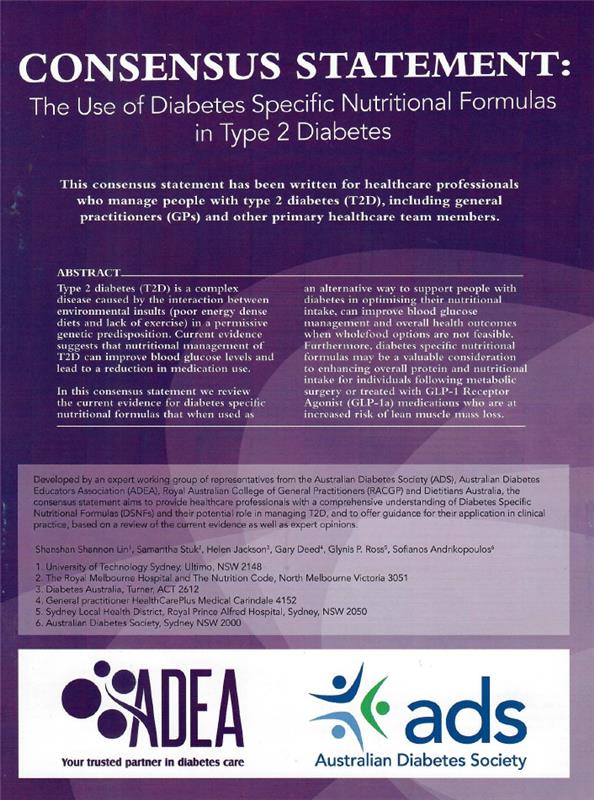
Developed by an expert working group of representatives from the Australian Diabetes Society (ADS), Australian Diabetes Educators Association (ADEA), Royal Australian College of General Practitioners (RACGP) and Dietitians Australia, the consensus statement aims to provide healthcare professionals with a comprehensive understanding of Diabetes Specific Nutritional Formulas (DSNFs) and their potential role in managing T2D, and to offer guidance for their application in clinical practice, based on a review of the current evidence as well as expert opinions.2

The Clinical Practice Guide was developed by an expert working group comprising representatives from the Australian Diabetes Society (ADS), Australian Diabetes Educators Association (ADEA) and Royal Australian College of General Practitioners (RACGP) and other experts in diabetes care. It builds on the previously published consensus statement and aims to equip health professionals with evidence-based guidance to confidently integrate diabetes-specific nutrition formulas (DSNFs) into the management of diabetes in clinical practice.3
GLUCERNA IS THE ONLY DSNF BACKED BY OVER 30 YEARS OF RESEARCH^
Glucerna is formulated specifically for people with diabetes or impaired glucose tolerance, with a low GI slow-release carbohydrate blend aiding slower glucose absorption. Glucerna also contains a key ingredient called myo-inositol. Inositol is a carbohydrate produced by the body and found in some foods. Research has shown to support glucose uptake from the blood.4-6
Glucerna should always be integrated as part of a holistic diabetes management plan including a healthy diet and physical activity and under the guidance of a healthcare professional.
HOW DSNFs COMPARE TO OTHER NUTRITIONAL PRODUCTS

HOW CAN GLUCERNA SUPPORT GLP-1 RA THERAPY:
1. Preserving lean mass including skeletal muscle
Because GLP‑1–based therapies are associated with ~30% of total weight loss coming from lean body mass1 loss as weight falls, using a Diabetes Specific Nutritional Formula like Glucerna can help supply high-quality protein and micronutrients to support muscle maintenance (coupled with resistance exercise). 7
In a randomised trial of 235 people with type 2 diabetes, using 1-2 Glucerna servings as partial meal replacements over 90 days led to 2 x lean mass (including skeletal muscle) increase. 7
2. Supports weight management while protecting lean mass
Along with the lean mass increase mentioned in the study above, using 1-2 Glucerna servings as partial meal replacements over 90 days also led 2 x greater weight loss of visceral adipose tissue (belly fat)+8
3. Smoother glycaemic response
Glucerna is clinically shown to keep glucose levels in target range up to 90% of the time.+8
Glucerna is a Food for Special Medical Purposes. Use under medical supervision.
*When taken as a breakfast replacement as part of a diabetes management plan, people with diabetes consuming Glucerna kept blood sugar within the target glucose range of 3.9 - 10.0 mmol/L for an average of 89.5% of the time.
+The group receiving 1–2 servings of Glucerna daily as a (partial) meal replacement on top of standard of care (SOC) had a significantly greater reduction in body weight compared to SOC (2.27% vs 1.05%, p<0.001) and visceral adipose tissue compared to SOC (-6.52% vs. -0.95%, p<0.001) and significantly greater increase in lean mass (1.44% vs. 0.79%, p<0.05) at day 90 in a randomised controlled trial of 235 people with type 2 diabetes.
^Abbott data on file
References:
1. Beavers KM, et al. Obesity (Silver Spring). 2025;33:225–237
2. Lin S, et al. Diabetes Management Journal. August 2024:17-19
3. Lin S, et al. Diabetology. 2026;7(2):24 https://doi.org/103390/diabetology7020024
4. Bevilacqua A, et al. Int J Endocrinol. 2018;2018:1968450.
5. Dang NT, et al. Biosci Biotechnol Biochem. 2010;74(5):1062–67.
6. Yamashita Y, et al. J Agric Food Chem. 2013;61(20):4850-54.
7. Glucerna® Powder Product Label.
8. Tey SL, et al. Front Nutr. 2024;11:1400580
9. Peng J et al. Br J Nutr 2019;121:560–66.
Diabetes-specific formula with standard of care improves glycemic control, body composition, and cardiometabolic risk factors in overweight and obese adults with type 2 diabetes: results from a randomized controlled trial. Front Nutr. 11: 1400580.